Police Advice for Safe Roman Holiday Dampens Spirits

Roman police have issued a safety sheet that, while strong on common sense, makes a vacation in the Eternal City sound devoid of the merrymaking that makes Italy such a draw for tourists.

The how-to on keeping safe and enjoying Rome (surprisingly in decent English) downloadable from their website starts off by reminding tourists (and by tourists, we mean women) why they came: “Rome is a safe city and its people are welcoming,” but some of the advice they hope tourists will keep in mind is a bit of a downer.

First the useful info:
— in an emergency, call either 112 (local police) or 113 (carabinieri). (They left out the medical emergency number, 118.)
— women get a 10% taxi discount at night as yet another “pink” initiative.
— numbers for 24-hour women’s anti violence centers: (06) 5810926 or (06) 23269049.

Alas, though most of the advice is common sense, it rules out what draws many women visitors to Italy: don’t wear any flashy jewelry, drink in moderation, do not accept drinks from strangers, do not accept invitations from strangers and stick with the people you came with.

Ok, so Rossano Brazzi was never going to roofie Katherine Hepburn’s bellini (though he is shown in the “Summertime” poster staring intently at her with a large drink in hand) but has Italy become so dangerous that visitors are well advised to glare at the locals suspiciously while clutching half glasses of wine singing “O sole mio” wistfully to their American counterparts? And given the hundreds of stories, romantic and bittersweet, about foreign women in Italy, are they really expected to?

Image courtesy @ polizia di stato
Financial Crisis Puts Italian Men to Work at Home

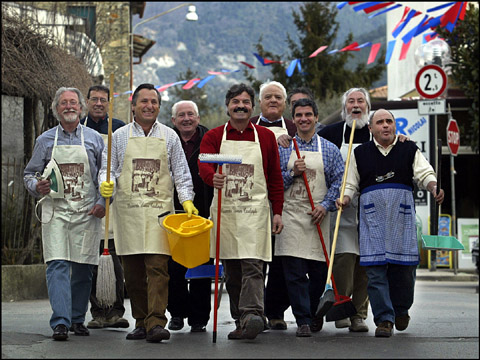
househusbands

By many accounts, Italian men are some of the laziest in Europe when it comes to lending a hand at home.

According to the national association of house husbands, 70% of Italian men never cook, 90% have never, ever, ironed a shirt, 95% have never done a load of wash.

With the financial crisis hitting Italian households, that may change. Some 34% of Italian women have cut back on household help, a recent survey by Coesis announced. They’re also looking to husbands and family to start lending a hand, researchers noted.

It’s about time for men to step up and help out, says the house husband association.

“Women are really sick of it, they’re used to having to pay to get the help they might expect from a husband or partner,” said president Fiorenzo Bresciani. “If they can’t afford that, now’s the time to re-discuss who does what around the house. Men are definitely the ‘lazy sex,’ we want to show them that real men do help out.”

Born in 2002, the Tuscan-based association, which offers master classes in home management (“the science of ironing,” anyone?) now counts over 4,000 members.

I suspect the biggest challenge may be men over 50, who have never helped out and probably don’t see much reason to change that. A lot of younger Italian guys I know are great cooks and decent about taking care of la casa.

Does your Italian man help out around the house?

Photo courtesy Italian Household Association

Rediscovering Italy’s Pilgrim Route: La Via Francigena del Sud

eric2

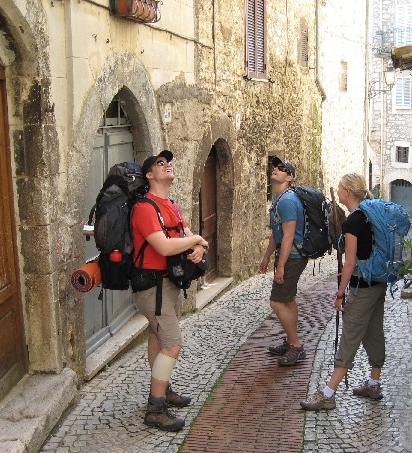
Fellow reporter and friend Eric Sylvers is on the road again, this time he and three friends are walking the lower half of Italy’s pilgrim route to where the boats once left for Jeruselem, the Via Francigena del Sud, 500 kilometers (310 miles) from Rome to Otranto, Puglia.

While the northern part of the trek — from the Gran San Bernardo Pass in Switzerland to Rome he did in 2007 was fairly well marked, this leg sounds like the epitome of the road less traveled.

His daily blog, with tons of photos and video, about the peregrinations tells of having “celebrity status” in Campania and getting lost:

“Just before Amorosi we had been through a town called Ruviano were we made the acquaintance of Giuseppe, who left nearby Avellino for the United States when he was 19 and lived there for 50 years before coming back to retire to his native Campania four years ago. Colorful Giuseppe kept us occupied for quite awhile and so it was with the slowest of paces that we made our way towards Solopaca, our intended stop for the evening before our push to Benevento tomorrow.

After getting lost in the hills near Solopaca for a good 90 minutes we came to the very disheartening realization that as there was nowhere to sleep in the town and we were going to have to walk further and away from Benevento. Disheartening as that was, we eventually ended up in a small hotel on the edge of a picturesque small lake. The walk, which was under a scorching sun, had us weaving around some hills until we had some proper climbing on the approach to Solopaca.”

Fascinating — though I’m more likely to sign up for the trek when it’s a little less adventurous…

Image courtesy / copyright @ Eric Sylvers

Pasta la Vista, Baby: The Changing Italian Diet

25 years ago, Italian families ate more meat, drank more wine but put less fish and pasta on the table. La famiglia also usually shopped in small local stores — there were five times fewer supermarkets — and 85% of the time ate at home.

These are some of the changes tracked in a study (.pdf Italian only) by national food industry lobby Federalimentare to mark its 1983 founding, back when Socialist Bettino Craxi first stepped into office and pop hit “Vamos a la Playa” had Italians singing into their watches.

Rapid changes after World War II first revolutionized Italian eating habits, breaking some long-standing stereotypes. In the early 1950s, the Italian mamma spent a good chunk of her day preparing a hearty lunch, while her new millennium counterpart, less likely to be a stay at home mother, spends just a third of that time in the kitchen.

In the post-war period, Italians also spent half the family income on food. From 1983-2008, money spent on groceries dropped eight percent to 17.7% of the budget. They now eat 10% less meat, 10% more pasta and bread but about the same amount (18%) of fruit and veg. Beverages have flip-flopped: Italians now spend 5% of the budget on juice, bottled water and soda, five times more than in the 1980s when that same percentage was allotted for wine and spirits.

Some staples of the Italian postwar diet that have now disappeared include smoked herring (often eaten with polenta), tinned milk and carob beans, sucked like candy.

Image used with a CC license, thanks orsorama