
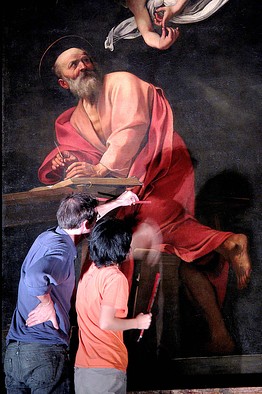
Replicas to Bring Painter Caravaggio Back Home

Last fall, a group of specialists worked late into the night, perched on scaffolding in a Roman church, trying to copy Caravaggio’s “Inspiration of St. Matthew,” rendering the image true right down to the subject’s dirty feet. Every night for two weeks, they set up a scanner to photograph the Contarelli Chapel paintings, part of a project to make a facsimile of the baroque master’s works for a research center in Caravaggio slated to open this September.

Meanwhile, two years ago in Venice, a lifesize facsimile of Paolo Veronese’s monumental work “Wedding at Cana” drew 20,000 visitors in three months, while the real 16th-century masterpiece is often ignored by tourists waiting to see the “Mona Lisa” at the Louvre museum in Paris.

Another state-of-the art copy — of Leonardo da Vinci’s “Last Supper” in Milan — attracted nearly 55,000 visitors to an exhibit so popular the dates were extended twice. It was an unexpected hit born out of compromise. Director Peter Greenaway was asked to create a short film to project over the original Renaissance fresco at Santa Maria delle Grazie but officials got cold feet about crowds and conservation. His 20-minute short was projected only once over the original to a handful of dignitaries during the 2008 International Milan Furniture Fair. Shown over a high-resolution copy at nearby Palazzo Reale, the installation stayed open for five months.

Whether to rewrite history or reinterpret masterpieces, replicas made with a palette of high-tech tools are changing the way tourists see art.

All three of these faithful fakes are the work of Madrid-based Factum Arte, a company that employs high-resolution 3-D scanners of its own devising to reproduce artworks.
The scans result in thousands of files whose images are stitched together, then churned out by flatbed pigment printer onto canvas primed with historically accurate paints. To get the clone closer to the real thing, conservators fill in any ridges or creases from manhandling or restoration by hand afterward.
Continue reading
Priest launches mother-in-law training to curb divorce

Meddling mother-in-laws have been the basis of jokes, pop songs, and heartbreak probably since men dragged their young brides back to the family cave.

One enterprising Italian priest, convinced that in-laws are behind the country’s increasing divorce rate, has devised a class to teach them to help rather than wreak havoc on their children’s relationships.

Called “Families in Dialogue – How to be Effective Parents to Married Children,” the course is taught by three psychologists and is open to both male and female in-laws.

Held over the course of three weekends in the northeastern city of Udine, sessions are dedicated to such hot-button topics as surviving Sunday lunch (a little over half of Italians still meet for this weekly ritual) and negotiating babysitting duties.

The idea for the anti-meddling class grew out of the problems that Don Giuseppe Faccin had while teaching pre-matrimonial classes.

“Statistics show very clearly that at least three out of 10 Italian marriages are in crisis due to the in-laws,” Faccin told local daily Il Messagero Veneto. “Sometimes the problem is both in-laws. More often than not, we have to work on the relationship between the parents.”

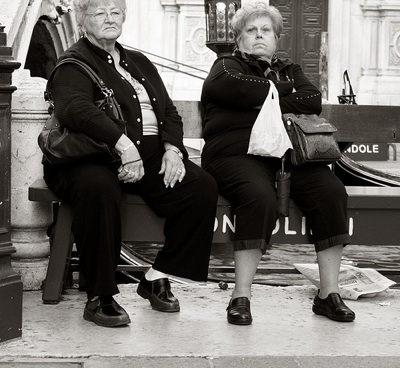
Strong ties in Italian families are often at the root of the problem: at age 29, 70% still of Italian men still live at home and even when they leave the nest, one in three talk to la mamma every single day.

“When children get married, parents should regain their own balance as a couple again, but often they’ve spent so much time caring for adult children that they don’t know how,” Faccin explained. “So they throw their energy into their children’s marriage, intervening in ways that aren’t helpful. Even as grandparents for lack of other projects and ways to spend free time they end up interfering more than helping.”

You have to wonder if a truly invasive in-law would sign themselves up for such a course, though.


CC-licensed photo, thanks vanz.

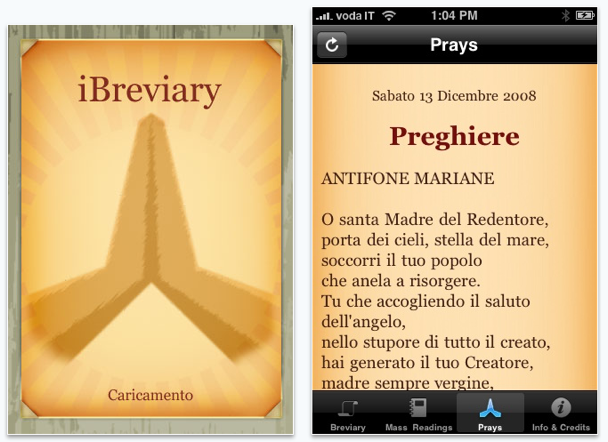
Vatican Approved Prayer App Now Gratis

The Italian priest who created the only Vatican-approved prayer app has now slashed the price from $0.99 to gratis.

Given the popularity of the iBreviary app, Don Paolo Padrini decided to give the current version away for free. (Profits from the app previously went to refurbishing a parish shelter.)

Available in English, French, Spanish, Italian, Latin and an Ambrosian Rite version (for mobile Milanese), this virtual breviary, or book of hours, gives the morning prayer, evening prayer and night prayer or complines for the day. It is the first app of its kind to obtain approval from the Vatican.

As a paid app, it was in the top 100 of its category (reference) beating out similar mobile prayer helpers like iPieta and iMissal.

What’s next? Don Padrini tells us his developers are hard at work on an iPad version they hope will be ready to launch when the new device hits stores.

Barter for a Bed at Italian B&B

If you’re short on cash but with some kind of marketable skill — photography, a foreign language, accounting — a Milan bed and breakfast just may be the ticket.

At Bed & Breakfast Porta Garibaldi in central Milan you can trade your talents for a place to sleep year round. The idea is the brainchild of owner Alessandra Maggioli, who also lets the studio apartment which can sleep a couple or two singles for 90 to 130 euros a night pictured above. So far Maggioli has accepted a case of good wine for a weekend, a painting by a young artist and another guest is helping her design a web site.

If you don’t need a place to crash in Milan but would like to barter plan ahead: there’s a whole circuit of Bel Paese B&Bs that for one week a year accept trades instead of cash. This year it falls from November 15-21, you can check out offers on the website.

Smart swappers may want to stay where it’s warmer or where there’s something nearby to do — nothing worse than a seaside town shut down for fall — but the idea is a good one.

An easy swap that comes to mind would be a quick, accurate translation of individual B&B websites in English or other languages.