
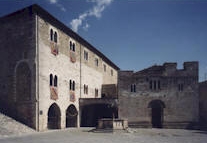
Italy’s top town? For number gurus, Bevagna (Umbria)

zoomata.com staff

For the third year in a row statisticians wrote a love letter to Bevagna, a medieval hamlet in Umbria, naming it highest for standard of living in Italy.

Research institute Censis studied over 100 cities and towns throughout Italy, finding many of them like Milan and Rome growing and dynamic but choked by traffic and smog or small but drained of life in the city center.

Censis president Giuseppe De Rita says he fell for Bevagna in 2001, after attacks on the Twin Towers. “We were all expecting a world war and it occurred to me that this war would never come to a place like Bevagna, ” he commented in the cities report.

With good reason: many Italians would be hard pressed to locate it on a map, although Bevagna lies 35 kilometers (22 miles) from Perugia and about 150 kilometers (93 miles) from Rome. This walled city with a population of 4,700 features Roman baths with mosaics, an arena, nearly a dozen historic churches and plays host to a medieval market in June.

De Rita coined the awkward term “bevagnization” to describe what Italian towns should strive for: a place where one can walk to work, let children play in the streets and leave the front door unlocked but with a vital trade in tourism.

Bevagna, close to where St Francis is said to have preached to the birds, made a rare appearance in the national news recently for allowing locals to shoot pesky pigeons cluttering up the city center.

? text 1999-2004 zoomata.com
This is an original news story. Play nice. Please use contact form for reprint/reuse info.

*image courtesy @ copyright city of Bevagna

Related resources:
http://penelope.uchicago.edu/Thayer
Bill Thayer’s extensive photo journal of Bevagna (English)

Italian Country Hideaways: Vacationing in Tuscany and Umbria’s Private Villas, Castles, and Estates
Bevagna @ beyond…
Italians more passionate about pasta than sex

zoomata.com staff

Most Latin lovers prefer a plate of pasta to a paramour, according to a recent study. One-third of all Italian of both sexes indicated pasta as the main pleasure in life. According to the SWG poll, nearly half of them would never go without it.
Sex? L’amore as a life passion warrants a mere bronze, coming in after travel preferred by 27% and 21% of Italians respectively. Intellectual pursuits would seem to be of higher importance than rounding out a that plate of pasta with a glass of wine: reading was cited as a passion by 14% percent of Italians while wine only by 4% percent.

Passion for pasta may also lead to a national sense of guilt if another poll by SWG of over 1,000 Italians is to be believed. Half of all Italians feel they are overweight, when only 34% of them are in actuality. And low-carb diets won’t make much headway in Italy any time soon: 60% of those interviewed ate pasta or pizza at least five or six times a week and some up to twice a day.

Although about half of Italians can be considered overweight, they still boast trimmer waistlines than many Spanish, Greek, German and Belgian counterparts. Surgeons cited sedentary lifestyles and “American-style” fast food as plumping up the national girth, warning that in a few years Italian rates may catch up with U.S. obese averages, currently about twice as high. ?1999-2004 zoomata.com
This is an original news story. Play nice. Please use contact form for reprint/reuse info.

Related resources:
Marcella Says: Italian Cooking Wisdom from the Legendary Teacher’s Master Classes

Cindy Hayes, (Catania, Sicily)

First Person: real life in Italy

Each month we introduce you to someone who has made the dream of picking up and moving to the Bel Paese a reality.
In their own words they share the good parts, the bad parts and the just plain absurd moments of day-to-day life in Italy.

ID Card:
My name is Cindy Hayes; I am an American living in Italy. I am 48 years old, single and having a blast here!

I teach advanced levels of English to professionals and upper university students, which includes the American culture as well as the language.

I have a daughter that is in the US Navy, married and has just given me a beautiful new granddaughter. I have spent time exploring much of the world, including living in China for more than a year.

So I have a pretty good basis for my opinion of Italy! If any of you are planning to come to Italy, in particular Sicily, feel free to email me at: CindyinSicily@hotmail.com Continue reading

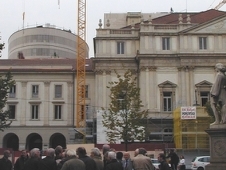
Milan?s opera house La Scala restored to former glory

zoomata.com staff Italy?s premier opera house La Scala has come out from under wraps after a three-year restoration.
Inaugurated in 1778, the theatre had to be renovated extensively to meet modern building codes and safety standards. The decision to make over other parts of La Scala during the restoration led to nearly-operatic and very Italian drama that began as soon as the ink was dry on the plans.

Both camps will be eager to view the new theatre on December 7, when the season opens with Antonio Salieri’s “Europa Riconosciuta,” the same opera that La Scala opened with in the 1700s.

After a smattering of performances in December and January, La Scala productions will return to the interim Arcimboldi theatre while technicians perfect the new set-changing equipment. A key feature of the renovation, these prototypes developed specially for La Scala are expected to double the number and variety of offerings per season from the current 80 operas and 40 ballets.

Visitors should keep a close eye on the schedule because throughout the spring some of the productions, including Giselle and The Barber of Seville, are offered at La Scala. In the interim the public can view the face lifted La Scala on organized tours. All the great Italian composers have written for the opera house, notably Verdi, Puccini, Bellini, Rossini and Donzinetti.?photo + text 1999-2004 zoomata.com
This is an original news story. Play nice. Please use contact form for reprint/reuse info.

Related resources:
http://www.teatroallascala.org/eng/sommario.htm#

2004- 2005 schedule in English

Italian scientists solve historical murder mystery

by Nicole Martinelli

When fighting knight Cangrande della Scala of Verona buckled to the ground after drinking from a fountain in 1329, many called foul play.

Some 675 years later, scientists took out his perfectly-preserved mummy hoping to solve this ancient murder mystery. A team of experts lead by Gino Fornaciari, also in charge of digging up 49 members of the Medici clan in Florence, took him from the crypt for a 48-hour work up with state-of the-art technology. Archeologists, paleontologists and forensic specialists ran a battery of tests, including DNA tests and CAT scans, then spent months analyzing them.

The result? Cangrande was poisoned. The 38-year-old Lord of Verona died from an overdose of digitalis, a medicine made from foxglove leaves, commonly administered as a powerful cardiac stimulant and a diuretic. Even modern technology, however, can’t clear up whether he was murdered or simply a victim of medical malpractice.

Cangrande had just been handed the keys to conquered city Treviso when he fell ill. The physician examining his swollen belly may have mistakenly took the symptom for cardiac insufficiency when, in fact, experts now know that Cangrande suffered from a viral-induced cirrhosis. The digitalis given to jump start the knight made his liver collapse.

At the time, locals had little doubt: a year after Cangrande’s death, they hung the doctor as responsible for the killing though they never did ascertain whether it was an accident or part of a plot.

Cangrande, that’s ‘Big Dog’ in Italian, is alternately described as a typical tyrant and man of letters. He brought Verona to the height of its power and was also patron to Dante in exile who, in thanks, gave him a mention in the Divine Comedy.

Lest the townspeople forget him, a large equestrian monument with sarcophagus looms over the center of town. Cangrande’s enigmatic smile will continue to keep the secret of his death while visitors explore the results of modern scientific sleuthing in an exhibit at the Castelvecchio museum on until Jan. 23, 2005. ?1999-2004 zoomata.com
This is an original news story. Play nice. Please use contact form for reprint/reuse info.