
High-Res Last Supper Reveals Leonardo’s Secrets

Last Supper in Hi-ResA 16-billion-pixel image of Leonardo da Vinci’s The Last Supper — said to be the world’s highest-resolution photo — went online Saturday, making the masterpiece available for scrutiny by art lovers everywhere.

White-robed Dominican monks opened the doors of their sacristy to unveil the high-res image of the painting on a giant screen just steps away from the real thing at the church of Santa Maria delle Grazie.

The digitized version, produced using special techniques designed to protect the fragile painting from damaging light exposure, gives anyone with an internet connection a chance to dig deeper into Leonardo’s techniques than ever before.

With the air of chiding an old friend, Leonardo expert Pietro Marani zoomed in on the cuff of traitor Judas to show the gold flake Leonardo applied.

“He went against his own better judgment here,” Marani said. “We know he considered using real gold a cop-out, that he thought true artists should be able to make paint glitter like gold, but there it is.”

For a close-up on the workings of a genius, Marani recommended viewers search the Last Supper for the church bell tower and shrubs outside the windows, the patterns and wrinkles in the tablecloth, the reflection of an orange wedge in a pewter plate in front of Matthew and the perspective lines in the upper left-hand corner that lead (imperfectly) to Jesus’ eye.

Leonardo used oil and tempera paints on dry plaster, an experimental technique, and as a result, the Last Supper is now so faded and cracked it can’t withstand exposure to bright light. To protect the painting, HAL9000 worked with restoration specialists at Rome’s Istituto Centrale per il Restauro to develop a lighting system without the ultraviolet emissions and high thermal impact so hazardous to works of art. Shot with a Nikon D2X digital SLR in just nine hours, the total impact of the digitization process was equal to just a few minutes of the soft lighting that normally illuminates the painting.

More from zoomata’s Nicole Martinelli at Wired.
Neutron Beams Search for Da Vinci’s Lost Masterpiece

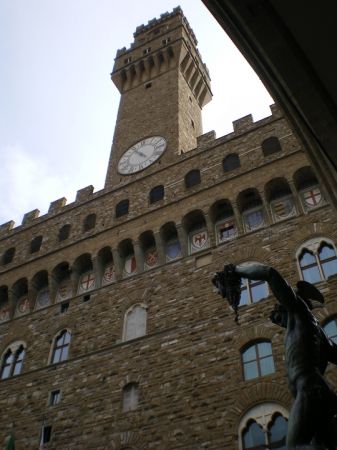
palazzo vecchio florenceFLORENCE, Italy — Art diagnostician Maurizio Seracini has waited 30 years to get to the bottom of his biggest mystery yet: whether Leonardo da Vinci’s greatest lost fresco lies behind a wall in the Palazzo Vecchio here.

Seracini’s team of 30 will scan the palazzo’s 177-foot-long wall in mid-November, looking for the Battle of Anghiari, a work so magnificent it has been called the “school of the world.” The $1.5 million search expedition will jump-start a multidisciplinary conservation program at the University of California at San Diego’s Center of Interdisciplinary Science for Art, Architecture and Archaeology.

Since founding the art- and architectural-diagnostic center Editech in 1977, Seracini — a fourth-generation Florentine — has synced studies in engineering, art history and medicine to examine more than 2,000 buildings and artworks. He augments standard archival work with the use of ultrasound, X-rays, infrared, thermography and ultraviolet devices.

Editech’s notable discoveries include the original positions of the Three Graces in Botticelli’s Allegory of Spring and the hasty cover-up by a lesser hand of Leonardo’s Adoration of the Magi, which earned Seracini a mention as the only real-life character in Dan Brown’s The Da Vinci Code. Full story at Wired.

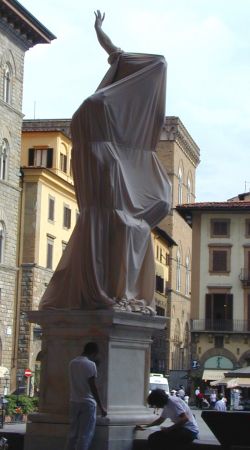
Florence: smog may drive Giambologna indoors

GiambolognaGiambologna’s virtuoso marble statue “Rape of a Sabine” may be the latest work to head indoors because of pollution.

The powerful, writhing trio has been in the Loggia dei Lanzi next to Palazzo Vecchio since Giambologna laid down his chisel in 1583.

In 2001 (when I took this photo), restorer Alberto Casciani blasted the grime off using laser and tried several different “chemical shields” hoping to leave the statue in its original context, according to daily Il Corriere della Sera.

Every six months, the surface was checked for damage but the results haven’t been encouraging. Officials will decide whether to take the statue inside and leave a resin facsimile to face the elements in early 2008.

A big chunk of Florence’s statues has already headed indoors for protection, including the base of Benvenuto Cellini’s “Perseus” which Francesco I de’ Medici commissioned Giambologna to provide a counterpoint for in the loggia.

Critics are calling it a further example of the “museumification” of the city, but how much does this matter to the average visitor? Hard to say. The last time I was in Florence, a young foreign couple asked me how to get to Piazza della Signoria to see the “David.” I gave directions but pointed out that it was just a copy, Michelangelo’s original is in the Accademia. “Doesn’t matter, we just want to see one of them,” was the answer.

Testing Italy’s iRosary

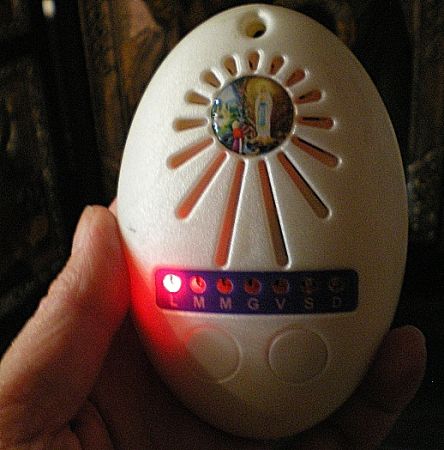
e-rosaryFor Catholics who can’t remember their Hail Mary’s, there’s help: an electronic rosary.

Long a joke in the tech community, two ingenious Italians are the latest to launch an e-rosary.

I went to check it out a couple of weeks ago at one of the religious book stores here in Milan, where it sat on top of a glass case filled with elaborate ex-votos. The clerk was busy with an elderly signora, a regular, buying a block of Mother Teresa prayer books, so I had the chance to fiddle with it.

Version 1.0 of the rosary pod looks like a big, lightweight egg — nearly filled my hand — but felt as if only the will of God might keep it glued together. It is, however, easy to use: I accidentally set it off almost immediately, then couldn’t figure out how to get the woman’s droning voice to stop. (It is also oddly sans headphones.)

One of the inventors, Onorio Frati, told the AP recently that he created it to pray on the job. This seems a clunky solution at best, even with the smaller shuffle version.

Prices start at €29.50 (US$41.70), which seems a lot, considering a no-name mp3 player with enough memory for the rosary and the Pope’s podcasts costs about the same.

More than for busy workers, it seemed targeted towards tech-phobic old people, but I couldn’t imagine any of the spry nonna-types I know using something cumbersome and unlikely to look nice sitting around your house or coming out of your handbag.

There have been plenty of attempts to create portable religious aids, but none of them have really been super-fervent solutions.

Maybe Steve Jobs will get on the case.