Italians Say “Si” to Sunday Lunch

Sunday lunch

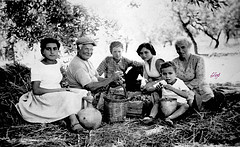
Times may change but over half of all Italians still break bread together on long, big Sunday lunches.

Though brunch has made headway in Italy recently, especially in cities and among young people, 52% of the 1,834 families polled by the Accademia Italiana della Cucina (Academy of Italian Cuisine) still follow the Sunday lunch tradition.

The menu? Usually cold cuts and crostini for starters, then pasta and roast meat plus fruit, dessert and coffee.

“In an age where all food is the same and people cook less, Sunday lunch is a bulwark against fast-food and ready-made meals,” said Accademia president Giovanni Ballarini. “It’s an important ritual to keep families together.”

This prodigal spread is still usually prepared by women, though two out of 10 men claim they “lend a hand” for Sunday cooking. Younger generations, say the study, aren’t interested in cooking, but are happy to sit down and eat with the extended family.

Photo courtesy Dpf at Flickr
Sign Your Name on Juliet’s Terrace in Verona

Juliet\'s terrace

Two million romantics flock to see Romeo and Juliet’s balcony every year in Verona.
Unfortunately, many of them also carve their names or scribble hearts on the monument, making it more of a tourist trap than attraction.

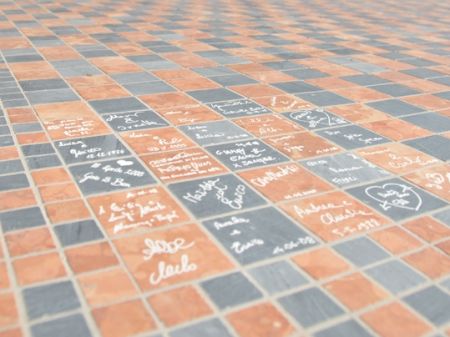
To stop love-struck tourists from ruining the building, managers of theater Teatro Stabile, who own the famous balcony, came up with the idea of “lovestones.”

For €100 (about $135) lovebirds have a their names (plus short message and date) carved in laser on marble tiles on a terrace below the balcony. You also get a certificate with a map and can also request copies of the tile, for €35 (about $45).

There are some 60,000 lovestones available, organizers assure that someone will be on hand to help you find yours, should you come to Verona to see it.

Love may not be eternal, but these these lovestones will last indefinitely. Or at least until the natural abrasion erodes the marble surface.

Purchase of the tiles will help modernize the 1846 theater.

Italy Faces Foreign Truffle Invasion

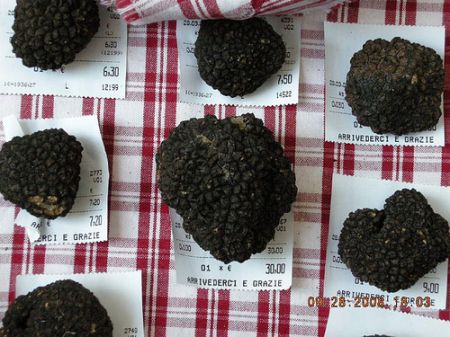
Italian Black truffles

Italian researchers nosing around have discovered traces of DNA from Chinese truffles mingled with prestigious, costly local black truffles.

The trouble with truffle intermingling? Scientists say it is one reason, along with environmental changes, that the prized tuber has become even more scarce in recent seasons.

Truffle cousins from Asia sprung up in European markets in the 1990s. Among them is the Tuber indicum from China, a close relation of the Italian black truffle, Tuber melanosporum. The two mushrooms share genes and have a similar structure and shape. Truffle conossieurs, willing to pay between €200 and 600 per kilogram (USD$130–$380 per pound) for this black gold, say the Asian variety lacks the taste and fragrance of Italian truffles.

During an inspection of a black truffle farm near Turin, where a dozen years ago T. melanosporum truffles were planted, researchers of the Institute for Plant Protection (IPP) of the National Science Council identified DNA of T. indicum in the soil and roots.
Continue reading

Menu for Leonardo’s “Last Supper” Discovered

Just what was on the table in Leonardo Da Vinci’s “Last Supper?”

Historian John Varriano has his theory, outlined in Gastronomica in a pithy account which draws inspiration from Leonardo’s shopping lists and anecdotes from Vasari.

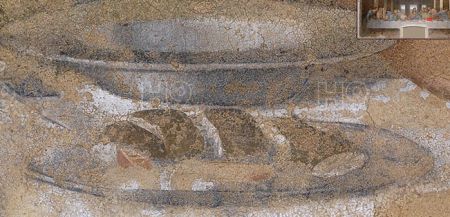
The plates in front of Andrew and Matthew—the fourth figures to Christs’ right and left—are heaped with food. Not bread and lamb, as previously thought, but eel.

Varriano says the three serving dishes on the right are grilled eel with orange slices.

If you’re curious about what was on the menu, Varriano’s theory is easy enough to check out. The Last Supper was scanned in 2007 in a project to make it the world’s highest-res photo. leonardo last supper table

Armchair investigators can zoom in on the plates in question and get a much better look at the than provided in the article.

The orange slices are clearly visible. The eel? Hard to tell. Leonardo’s experimental paint techniques left a disastrous, flaking mess.

Gray-ish blobs certainly appear fish-like, reminiscent of eel dishes still eaten by Italians during the Christmas holidays.

Any guesses?