
Italian Inmates Work on Al Capone’s Farm

Inmates at Milan’s Opera prison work on a farm named after famed gangster Al Capone.

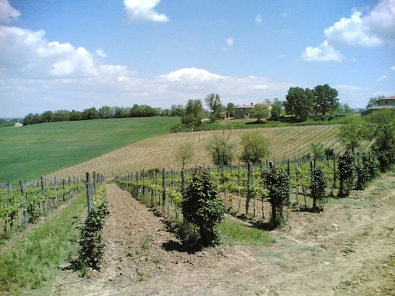
The name, Fattoria di Al Cappone, is a play on words from the Italian “capone” or capon, though the 15-or so men who work here raise quail and a few crops.

ivanpart

In 300 square meters on prison grounds (about 3,200 square feet), they raise the birds whose eggs are sold at a nearby Coop supermarket and a farmer’s coop, Consorzio Cascina Nibai, in the outskirts of Milan.

Launched a few months ago, the farm is the brainchild of journalist Emilia Patruno, a long-time prison volunteer whose association il due also developed the “stolen kisses” chocolates project.

Funded by a bank, before hitting the hoes inmates followed training courses given by the farmer’s coop. The group is working on a new potato, a purple Andean variety, that it hopes to patent for when the Expo comes to Milan in 2015.

Image courtesy Fattoria Al Capone.
iPhone App for Italian Soccer Games

iskySoccer fans can keep up with Champion’s League games and Italy’s Serie A games on their iPhones thanks to a free web app developed in cooperation with Sky.

Stats, line-ups, photos, and play-by-plays (for the moment, in Italian only) are available at http://i.sky.it/

The web app was developed by CEFRIEL, an ICT research hub for three Milan Universities, with a special eye to Apple-friendly design. One example: a list of team members can be rotated horizontally to a soccer field view which shows the positions they play.

A lot of men here in Italy used to carry transistor radios on Sundays listening to soccer games.

Of late, these have been replaced by videophone services that allow fans ignore wives and friends while having a stroll. The nice thing about this app is that you can keep on top of the score without ruining conversation over Sunday lunch.

24 Karat Tuscany: Gold Found in Them Hills

Golden Tuscany

The rolling hills of Maremma near Grosseto are normally just considered a goldmine for tourists, but after two years of searching, geologists have found “significant” gold deposits in Tuscany.

“This is a land full of gold. Hundreds of indications point to it. Now the scope of our research is to search for a deposit,” geologist Franco Maranzana told Italian newspapers. “Because only if there is, as we suspect and hope, all the work we’ve done in recent years can become a business.”

Two Canadian firms are hunting for gold under the Tuscan sun, Adroit resources and Tuscan Minerals. They have permits to search in areas including: Follonica, Suvereto, Campagnatico, Manciano and Scansano, the hilly country better known for producing Morellino di Scansano DOGC wines.

Recession has just made the gold rush stronger. Analysts expect a gold price hike in 2009, which would make mining a more profitable business. The rub? Permits for research are some of the cheapest in Europe ( €8-9 euros a hectare) but mining permits are more difficult to wrangle. Both firms have research permits that will allow them to see if they can strike gold in 2009.

iPod Defense Rocks Perugia Murder Case

Holds toilet paper and an iPod, but is it an alibi for murder?

Holds toilet paper and an iPod, but is it an alibi for murder?

In 2007, British student Meredith Kercher was murdered in Italy, during a study abroad program in hill town Perugia.

About a year later, Rudy Guede was sentenced to 30 years for his part in the killing, for which Kercher’s roommate, American student Amanda “Foxy Knoxy” Knox and her boyfriend, Italian IT grad, Raffaele Sollecito, are still awaiting trial.

Guede’s appeal now before the Italian court hinges on an iPod.

During what has been hypothesized was some sort of late-night Halloween sex game where the 21-year-old Kercher was an unwilling participant, Guede maintains he was in the bathroom of the young women’s apartment.

While she was being killed with a knife, he was listening to music on iCarta, a toilet paper holder roll that doubles as an iPod dock.

Guede’s lawyers tried to head off what they thought might be viewed as a sort of Twinkie defense for the digital age in a statement to Italian media (below translation mine):

“It is nothing more than a confirmation of how some abnormal behaviors are apparently normal among young people today,” said laywers Valter Biscotti and Nicodemo Gentile. “Just as Facebook is their virtual world, they now listen to music everywhere, even in the bathroom. The marketing of such products implies a certain routine use.”

The statement was published without details on how the defense team might further the bathroom defense in court.