
Dan DeFebbo (Como)

Each month we introduce you to someone who has made the dream of picking up and moving to the Bel Paese a reality.
In their own words they share the good parts, the bad parts and the just plain absurd moments of day-to-day life in Italy.

Looking to move to Italy? Try the reader-recommended Survivor Package
Contact form

ID Card:
Dan DeFebbo; Profession – Telecommunications Sales Engineer.
email: miticodan@yahoo.com I’ve lived in Italy (this time) since 1998.

Currently living in: Como, Lombardia

By way of: Raleigh, North Carolina

How (or why) did you get here from there?
I grew up as a Navy brat. One of my father’s assignments was Naples when I was 15. I lived in Naples from 1975 to 1978 and fell in love with Italy. I loved it so much I came back in the US Army and was stationed just south of Venice for about 18 months in 1980.
I had always kept my eyes open for an expat position with my company in the US but nothing ever opened up. Then, in 1998, I found out about an internal position in Milan and jumped on the opportunity so I packed up my wife and two kids (ages 4 and 6) and headed to Italy. We decided early on not to live in Milan because it’s too dirty and after 3 years living in a suburb of Como, we moved into the pedestrian zone in the center.

What role did language skills play in your experience?
When I arrived, I spoke some Neapolitan dialect I had learned 20 years prior. It was funny because I arrived in Milan speaking like a street urchin from Naples. It was very amusing for Italians to see me, a very American-looking person, speaking dialect. Over the past 4 years, however, I have pretty much picked up a northern accent and speak much better. I can’t imagine surviving without speaking the language at least at the level where I could buy bread. I don’t feel like it is necessary to be fluent but you have to have a place where you can start.
My wife has had a difficult time learning the language which surprised me. In 1991, she took an intensive course and got along well when we came here for our honeymoon but this time around she struggles. She’s very smart but just hasn’t gotten the hang of it after 4 years. My kids went straight into Italian school without any problems not speaking a word and are fully fluent at this point.

Your biggest challenge:
Paperwork, paperwork, paperwork. I bore all my friends with horror stories about the questura here in Como. They are particularly unhelpful.

What did you do to feel at home or adapt here?
I have a couple of sources for American groceries here in Europe and have a constant stream of visitors who smuggle me stuff like brown sugar. Not so important for me because I prefer Italian food anyway, but the kids like to have peanut butter and chocolate chip cookies from time to time. My one necessity is underarm antiperspirant. For some reason, in Italy they only sell deodorant so I have to prevail on friends to help me keep my armpits dry.

What do you still have to get used to/learn?
I don’t write in Italian very well although my reading comprehension is very good. I don’t think I will ever get used to stores without parking, shops being closed for lunch, people passing you in a dangerous way just to cut you off to exit the highway, “colpo di freddo” rules, bad Mexican food, and the dreaded questura.

Compare an aspect of your home town (or other place you’ve lived) to current town.
In North Carolina, you have to drive everywhere. Even to pop down to the store for a quart of milk you have to fire up the SUV or minivan (per forza). In Como, I park my car on Friday after work and don’t touch it again until Monday morning. I live in a pedestrian zone so everything is within easy reach either on foot or by bike. I don’t know of anyplace in the US where you can do that.

Latest pursuits:
I try to take the family someplace every weekend. I would venture to say that we are out exploring Italy 30 weekends a year. Lately, I stayed in an agriturismo in the Chianti region, spend a couple of days on the beach in Liguria, visited London on a very cheap airfare, and visited France.

A preconceived notion about Italians/Italy that is not true:
Italian are fat.

A preconceived notion about Italians/Italy that is true:
The food is wonderful, the scenery is breathtaking, art and history abound.

Your response to the following question: “I really want to live here, but I don’t speak Italian or have a job. What do you think?”
Get a skill that is not very common in Italy (technical stuff) and learn the language. With a combination of those two things, you can easily find a job that pays fairly well. Lower your expectations as far as the size of your apartment and kitchen goes. Without a work permit, things can be pretty difficult.

How would you sum up your Italian experience in a word (and why)?
Casa. I feel more at home here than any place on earth.

Italy’s best kept secret (music, culture, food, way to get round things)
Sfursat wine from the Valtellina region around Sondrio on the swiss border.

Italians Clear Dante’s ‘Cannibal’ Count, Rebury Him

zoomata staff posted: Mon Dec. 28 11:49 am all bark no bite, Ugolino’s recontructed head

Centuries after Dante condemned him to nibble a skull for eternity in the Inferno, Ugolino della Gherardesca, the ‘Cannibal Count,’ is finally resting in peace.

He was put back into the family tomb, this time with honors, in a solemn ceremony in Pisa’s St. Francesco church presided over by local authorities, his descendants and two groups in historical costume.

Ugolino was found guilty of treason in the late 1280s. Left to die from hunger and imprisoned in a tower with two sons and two grandchildren, legend has it he staved off the inevitable by eating his offspring. He became one of the most haunting images in Dante’s Inferno, a macabre figure who wipes his lips with the hair of the skull he’s munching.

In 2002, the professor of ‘excellent cadavers,’ Francesco Mallegni discovered a box of bones in a crypt of the family chapel in Pisa and used samples from Gherardesca descendants to prove the remains belonged to the count.
DNA testing showed that Ugolino didn’t have much to bite the kin he spent his last days locked up in a tower with. The count, at an estimated 80 years of age, was nearly toothless.

Ugolino is one of the more spectacular discoveries made recently by Italian scholars and scientists who are busy digging up remains to find out more about historical figures. In November, 14th-century poet Francesco Petrarch was exhumed by a team of scientists eager to reconstruct his face and know more about his general state of health.

Anthropologist Mallegni, whose other discoveries include Giotto and verifying the corpse of Saint Ranieri, patron of Pisa, is already working on a new mystery surrounding bones found in a church in Aulla thought to be remains of St. Caprasio. ?1999-2004 zoomata.com

Zoomata is the brainchild of a bilingualjournalist based in Italy who thinks out of the box. This brain is for hire.

Pimp Fined for ‘Damaging Image’ of Italian Art City

zoomata staff posted: Thu. Dec. 24 15:49 pmProstitution and artistic splendor don’t go together, according to an Italian court judging a pimp in medieval jewel Perugia.
In a landmark sentence, a 22-year-old man was fined for “harming the image and historical patrimony of Perugia” and sentenced to three years of jail for forcing a minor into prostitution. Just how much he’ll have to pay for damages to the Umbrian city, 176 km (109 miles) north of Rome, will be decided by a separate court. Prostitution is not illegal in Italy but exploiting or coercing sex workers is a crime.

“Prostitution contributes to crime and the high visibility of prostitutes working the streets in the capital of Umbria harms tourism,” said prosecutor Antonietta Confalonieri. “This is the first time an Italian court has made a similar decision.”

Perugia, where Renaissance master Raphael learned the trade from teacher Perugino, is home to an important university, an international jazz fest and is considered capital of the Italian chocolate world.
The city center hasn’t always been off-limits to streetwalkers. Like many Italian towns, in 15th-century Perugia prostitutes were allocated a central red-light district between the two main squares to ply their trade.

City council member for social services, Wladimiro Boccali, is satisfied with the judge’s decision.

“It’s not about the money, though the fine will go to the association that helps take these women off the streets, ” he said. “We’re not going to remain indifferent to this slavery, we can’t pretend it’s not there anymore.”

There are an estimated 50,000-70,000 prostitutes in Italy, about 70% are illegal immigrants lured to the country with the promise of a job then forced into sex work, according to Eurispes data. The study reports almost half of all Italian men regularly frequent the so-called “fireflies” (lucciole), some 70% of these are married.?1999-2003 zoomata.com

Zoomata is the brainchild of a bilingualjournalist based in Italy who thinks out of the box. This brain is for hire.

Mussolini’s Bad Hair Days Become a Book

by Nicole Martinelli? posted: Wed. Dec. 14 15:23 pm
All of us have probably destroyed a photo highlighting a triple chin or lopsided smile, but things are a bit different when you’re the symbol of a political regime.

Italian dictator Benito Mussolini was ruthless when it came to discarding photos that showed him in, well, a less than a flattering light.

The trouble is that thousands of these snaps, with Il Duce’s cursive ‘no’ scrawled on them, made it into the hands of Italian historians who have put together a book of the rejects.
“Il Duce Proibito” (Forbidden Duce) serves up 140 pages of nixed photographs taken over a 15-year period.

What exactly did he want to keep people from seeing?

Topping the discards, all personally screened by Mussolini, were photographs portraying the normally lantern-jawed authority figure as jovial, informal or just plain awkward.

Take the one where Mussolini, in a slightly lumpy suit topped with a jaunty cap, gives an enthusiastic handshake to a uniformed and plume-hatted King Victor Emmanuel III.
The photo got the red light because Mussolini, in addition to the casual attire, standing in front of the royal car, might have been all too easily mistaken for the chauffeur. Other candid cast-offs immortalize him in tennis shorts and an overcoat, presiding over an empty piazza and making an ungraceful exit from an airplane in a puffy white aviator suit.

The forbidden Duce comes to light at a time when Mussolini is likely on spin cycle in his tomb in the northern Italian town of Predappio. Gianfranco Fini, leader of the neo-fascist National Alliance party, criticized the fascist regime during a recent trip to Israel. In the ensuing clamor granddaughter and senator, Alessandra Mussolini, left the party to form a new one amid speculation that her political clout has run dry.

Authors Mimmo Franzinelli and Emanuele Valerio Marin found over 2,000 ‘forbidden’ photos forgotten in the archives of Istituto Luce, which served as a propaganda arm for the fascist government.

The increasing number of photos rejected as the years went on make for a fascinating study in impression management. Mussolini became more and more fearful of his public image, prohibiting publication of photos where he was placed near priests or nuns, whom he was convinced brought him bad luck, and those where people around him appeared not to be paying ‘enough’ attention to his presence. ?1999-2003 zoomata.com

Zoomata is the brainchild of a bilingualjournalist based in Italy who thinks out of the box. This brain is for hire.

No-fault Divorce for Italian Husband in Sexless Marriage

A cheating husband who does not have sex with his wife is not to blame for the failure of their marriage, an Italian court ruled.
Rome judges of the Cassation Court, the country’s highest, ruled that husband Filiberto’s ‘continued’ philandering and ‘total lack of interest’ in having sex in his wife didn’t cause the breakup of their over 30-year union. Wife Monica (full names are not supplied in sentences to protect privacy) is entitled to a 250 e. monthly alimony check because of the no-fault ruling.

As author James M. Henslin pointed out in “Marriage and Family in a Changing Society,” until recent reforms in Catholic countries the only way to get a divorce was to prove adultery, because it meant ‘breaking a central property right, sexual access.’

The sentence delivers a jolt to the traditional stance of Italian wives who close an eye or two on their partner’s dallying to save the marriage. Because his wife accepted to live in a sexless marriage and knew of her husband’s affairs, the relationship was bound to deteriorate and fall apart, reasoned judges.

Another recent Cassation sentence also underlined that all is not fair in love and war, at least not in Italian marriages. The court sentenced a snooping husband and his accomplice friends to jail for tapping his wife’s phone, hoping to catch her cheating. Though he said he was trying to ‘preserve the unity of the family’ by keeping tabs on his partner, the judges ruled that the nosy trio had violated the woman’s privacy. The three men were sentenced to eight months in prison. ?1999-2003 zoomata.com

Italian Newspaper Sells Cross as ‘Gadget’

zoomata staff updated: Wed. Dec. 3 8:35 am

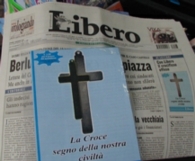
For an extra 1.50 euro, Italians can pick up the symbol of the Catholic Church with their daily news.

This is the latest installment in the national ‘crucifix soap opera,’which has been dominating media attention since late October after a Muslim in a small town won a court order to have the cross taken down in the elementary school attended by his two children. The resulting political and religious uproar had the school in Ofena (Abruzzo) shut down and then reopened, with the cross still hanging in the classroom.

“Yes, we’re selling the cross with the newspaper,” said chief editor of right-wing paper Libero, Vittorio Feltri, in an editorial today. “We’re not giving it away out of the fear that someone, not interested in the symbol of Christianity, might throw it away. It’s not nice to throw away the cross.” Profits made from sales will go to charity.

Feltri’s remarks came after a series of investigative reports showed that Italians aren’t always so touchy about the representation of the national religion – one large bronze crucifix, created for 2000 Jubilee celebrations, was discovered abandoned in a warehouse looking very much like an unwanted cadaver.

Religious publications in Italy often sell Catholic-inspired extras — from a comic book on the life of Pope John Paul II to the Bible in installments — but they rarely make it into the mainstream press. An unscientific poll of newsstands in central Milan would appear to show that the initiative is just another attention-getting antic — in two news outlets only one of the slim metal crosses had been sold so far.

“It’s just a way of dragging out the controversy,” newsstand owner Vincenzo told zoomata. “Most people are Catholics, but they aren’t practicing Catholics. I don’t see crosses flying out of here.” His most recent best-selling gadget, back ordered five times, was an EU-mandatory safety vest that cost an extra six euro.

Interested or not, it would appear that politicians throughout the country are jumping on the cross bandwagon. Between law proposals to make hanging the cross obligatory to regions purchasing truckloads to hang in schools and offices, this is one debate unlikely to end soon.
Adel Smith, who started the crusade to remove the crucifix, told Italian news agency ANSA that he plans to ask to remove the cross from the court hearing the case.”I don’t think I would feel sure of getting a fair hearing, with that hanging over the judges’ head,” he commented.@1999-2009 zoomata.com